The sound of tango
The bandoneón and the tango orchestra
What a bandoneón is, how a German concertina became tango's voice, how a tango orchestra is built and what to listen for in a small room.
Reserve your seats ↗Quick answer
The bandoneón is a type of concertina, a free-reed instrument held between the hands. It is tied above all to Argentina and Uruguay and is played in most tango ensembles. It was named for a German dealer, Heinrich Band, and reached the Río de la Plata in the late nineteenth century.
What the instrument is
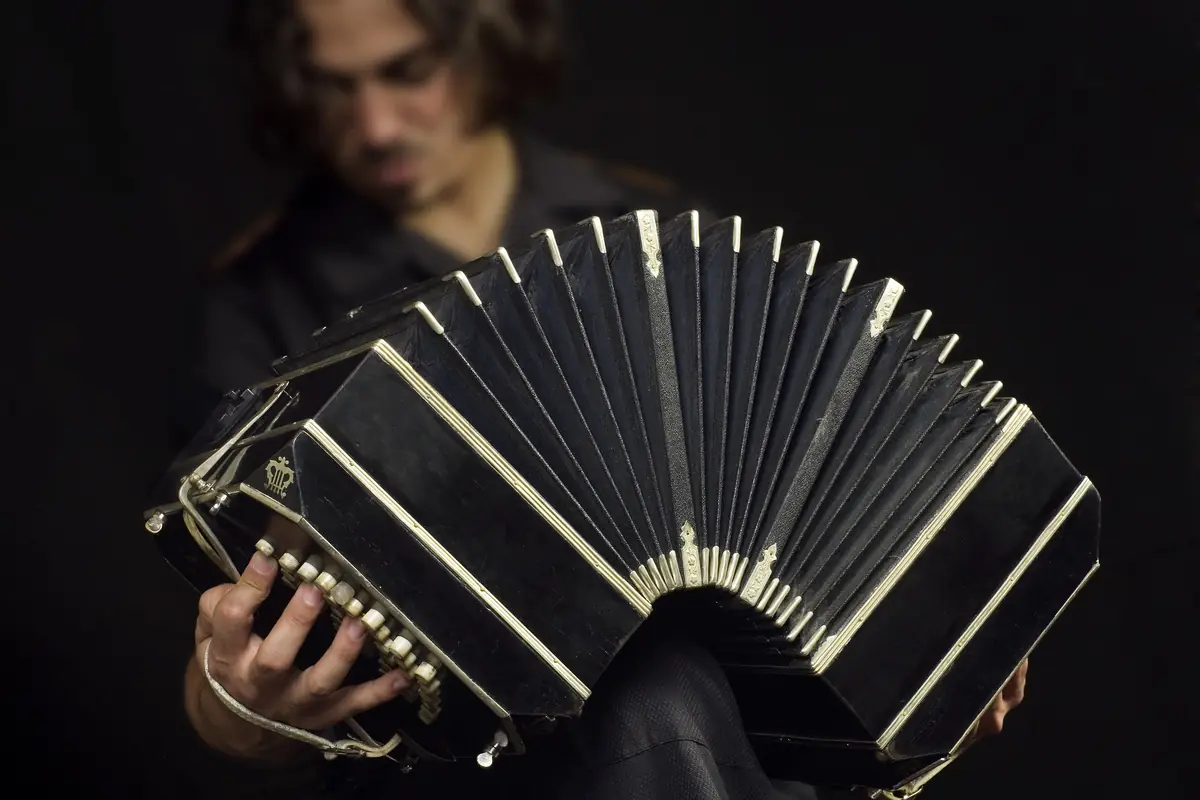
The bandoneón, also spelled bandonion, is a type of concertina. Players push and pull air through bellows, which sends it past tuned metal reeds chosen by pressing buttons. It is held between the hands, and the sound carries the tango's breathing, long phrases that swell and fall. Wikipedia notes that it is tied above all to Argentina and Uruguay and played in most tango ensembles.
A German name, a River Plate voice
The name comes from Heinrich Band, a German instrument dealer who lived from 1821 to 1860 and called it the Bandonion. Its predecessor, the German concertina, was mainly used in folk music, and the instrument was first meant for religious and popular music. Around 1870, German and Italian emigrants and sailors are believed to have brought it to Argentina, though there is no documentation of exactly how it arrived.
Who brought it into tango
Composers and players including Eduardo Arolas and Vicente Greco brought the bandoneón into tango. Pedro Maffia and Pedro Laurenz helped develop the sextet formation with two bandoneóns, which shaped the bandoneón section of the orquesta típica. Aníbal Troilo was a leading bandoneón proponent of the twentieth century. By 1910, Germany was making bandoneóns for the Argentine and Uruguayan markets, and about 25,000 were shipped to Argentina in 1930 alone.
Why it is hard to play
Most standard bandoneóns are bisonoric: each button sounds one note when the bellows are pushed and a different note when they are pulled. Players therefore have to learn four keyboard layouts, one for each hand and each direction. The left side has a wooden box that gives the left hand a nasal, muted tone, while the right hand is usually brighter and sharper. Many tango players play mostly on the pull stroke.
The keyboards in use
Some bandoneóns are unisonoric: they give the same note on the push and the pull. The Kusserow and Peguri systems, introduced around 1925, work this way. In Argentina, though, the rheinische system still dominates, with 71 keys and 142 tones. Mass production ended after the instrument's popularity declined and German manufacturing was disrupted during the Second World War.
The orquesta típica
Tango can be played on a solo guitar, a guitar duo or a larger ensemble called the orquesta típica. A full orquesta típica has at least two violins, a flute, a piano, a double bass and at least two bandoneóns, with guitars and clarinet sometimes added. Vicente Greco later standardised the tango sextet as piano, double bass, two violins and two bandoneóns, and golden-age orchestras often numbered over a dozen musicians.
From dance band to song
Tango may be purely instrumental or include a singer. Carlos Gardel helped develop tango canción in the 1920s, giving the music a lyric voice, and the sung form became central to the art. Tango music is in 2/4 or 4/4 time. Orchestras of the golden age, including those of Juan D'Arienzo, Francisco Canaro and Aníbal Troilo, were known for their distinct styles, which dancers still choose between at milongas.
What to listen for in a small room
In a small room you can watch as well as hear. Follow the bandoneón's bellows: a long pull on a held note, a short push for an accent. Listen for how the piano holds the beat while the singer or the bandoneón leads, and how the dancers respond to the phrase rather than to a metronome. The venue describes a collective of musicians, singers, composers and dancers who explore, improvise and inspire one another.
Frequently asked questions
Is a bandoneón the same as an accordion?
No. It is a type of concertina, and its button action runs parallel to the bellows, unlike the perpendicular action of an accordion.
Where does the name come from?
From Heinrich Band, a German instrument dealer who called it the Bandonion.
Does every tango show use a bandoneón?
Most tango ensembles do. The venue's own page describes a bandoneón among the instruments in its sessions.
Sources